
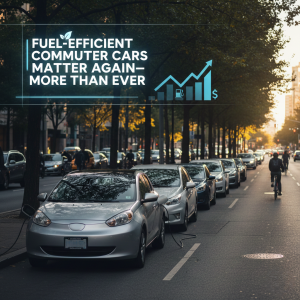
For several years, daily commuting quietly faded into the background. Remote work surged, rush-hour traffic thinned, and countless vehicles sat idle as garages doubled as storage spaces. Fewer miles were driven, fuel consumption dropped, and the morning commute felt—briefly—manageable.
That phase is ending.
Companies that once embraced work-from-home policies are calling employees back. Office parking garages are filling up, city traffic is rebounding, and highways that were temporarily tolerable are congested again—often worse than before.
As remote work cools, one factor in car buying has moved back to center stage: fuel efficiency for commuting. Not as a lifestyle statement, but as a practical necessity. Gridlock wastes fuel. Long drives drain paychecks. And inefficient cars make the daily commute more expensive than it needs to be.
Today’s commuter needs a vehicle that can handle:
- Sustained freeway driving at 40–80 mph
- Stop-and-go congestion that destroys fuel economy
- City streets, traffic lights, parking lots, and idle time
- High weekly mileage without excessive wear
- Reliability under daily driving stress
Most importantly, commuters need a car that uses fuel efficiently—not excessively.
That’s why buying a fuel-efficient used car has become the smartest option. It delivers peace of mind, lower operating costs, and proven reliability—without the price tag of a new vehicle.
Why Commuter Cars Matter More Today Than Five Years Ago
Imagine returning to an 8:00 AM commute after years of rolling out of bed minutes before logging in. Freeway merges are packed, traffic crawls at 20 mph, and a 90-minute drive has become routine again.
In this environment, fuel efficiency isn’t optional—it’s financial protection.
Daily commuting puts unique strain on vehicles by:
- Burning fuel during idling and low-speed congestion
- Increasing brake wear from constant stopping
- Forcing repeated acceleration and deceleration cycles
- Rewarding hybrids and EVs that thrive in traffic
- Penalizing low-MPG vehicles and inefficient engines
The right commuter car can reduce annual driving costs by thousands of dollars.
Freeway vs City Driving: Fuel Efficiency Works Differently
Fuel efficiency depends heavily on where and how you drive.
Freeway Driving
High-MPG gas vehicles perform best at steady highway speeds, especially those with aerodynamic designs and modern transmissions like CVTs. EV efficiency can drop at higher speeds due to increased battery demand.
City Driving and Traffic
Hybrids and EVs excel here. Regenerative braking, electric-only acceleration, and zero idling make stop-and-go commuting far more efficient than traditional gas engines.
Congested Freeways
Hybrids offer the best balance, combining gas power with battery efficiency while recovering energy during braking.
Bottom line:
- Mostly highway driving → high-MPG gas or eco hybrids
- Heavy traffic → hybrids or EVs
- Mixed conditions → hybrids are the most versatile
Understanding Fuel-Efficient Used Powertrains
High-MPG Gas Cars
Ideal for long-range commuting, easy refueling, and low ownership complexity. Modern transmissions help maximize fuel economy.
Hybrid Vehicles
Excellent for mixed driving. They deliver outstanding MPG in traffic while maintaining strong highway performance.
Electric Vehicles (EVs)
No gas, minimal maintenance, and low operating costs—but best suited for drivers with charging access and predictable daily mileage.
Best Used Electric Cars for Commuting
Used EVs are especially effective in traffic-heavy commutes due to instant torque, regenerative braking, and zero idle fuel loss.
Top options include the Nissan Leaf, Chevrolet Bolt EV, Tesla Model 3, Hyundai Kona Electric, and Kia Niro EV. Long-range trims are better suited for faster freeway driving, as EV efficiency drops at sustained high speeds.
Best Fuel-Efficient Used Gas Cars for Commuting
For drivers without charging access, efficient gas cars remain a strong choice. Brands like Toyota, Honda, Hyundai, Kia, and Mazda consistently offer reliable, high-MPG commuter vehicles.
Models such as the Toyota Corolla, Honda Civic, Hyundai Elantra, Kia Forte, and Mazda 3 provide excellent fuel economy, durability, and low ownership costs.
Tip: Turbocharged engines often achieve better highway MPG due to lower RPM cruising.
Top Used Hybrid Cars for Daily Commuting
Hybrids are ideal for unpredictable commutes that combine freeway driving and traffic congestion.
Standout options include the Toyota Prius, Honda Insight, Toyota Camry Hybrid, Kia Niro Hybrid, and Hyundai Ioniq Hybrid. Regenerative braking alone can improve efficiency by 10–25% compared to gas-only vehicles in stop-and-go traffic.
Real-World Cost Savings: Gas vs Hybrid vs EV
For a commuter driving about 18,000 miles per year:
- 40 MPG gas car: Moderate fuel costs, strong range
- 50 MPG hybrid: Lower fuel costs, best in traffic
- EV (250-mile range): Lowest energy cost overall
Depending on fuel prices and charging access, hybrids and EVs can reduce annual commuting costs by 35–75% compared to inefficient gas vehicles.
Choosing the Right Used Commuter Car
- Long freeway drives → Civic, Corolla
- Heavy congestion → Prius, Ioniq Hybrid
- Mixed driving → Camry Hybrid, Niro Hybrid
- Short-to-medium urban commutes → Bolt EV, Leaf
Final Thoughts
As offices reopen and traffic returns, the commuter car is back in focus. Fuel efficiency has become a form of financial freedom—saving time, money, and stress.
Buying a fuel-efficient used car isn’t just a practical decision anymore. It’s a smart long-term strategy that turns daily driving into measurable savings, mile after mile.